Research paper ·
Muskrat Falls: A Case Study in Megaproject Mismanagement
An examination of infrastructure finance, public risk, and accountability in a Canadian hydroelectric megaproject.
- Case study
- Muskrat Falls hydroelectric project
- Course
- URBS 470
- Institution
- Concordia University
- Deliverable
- Research paper
Methods & skills
In this report 5 min read
Research focus
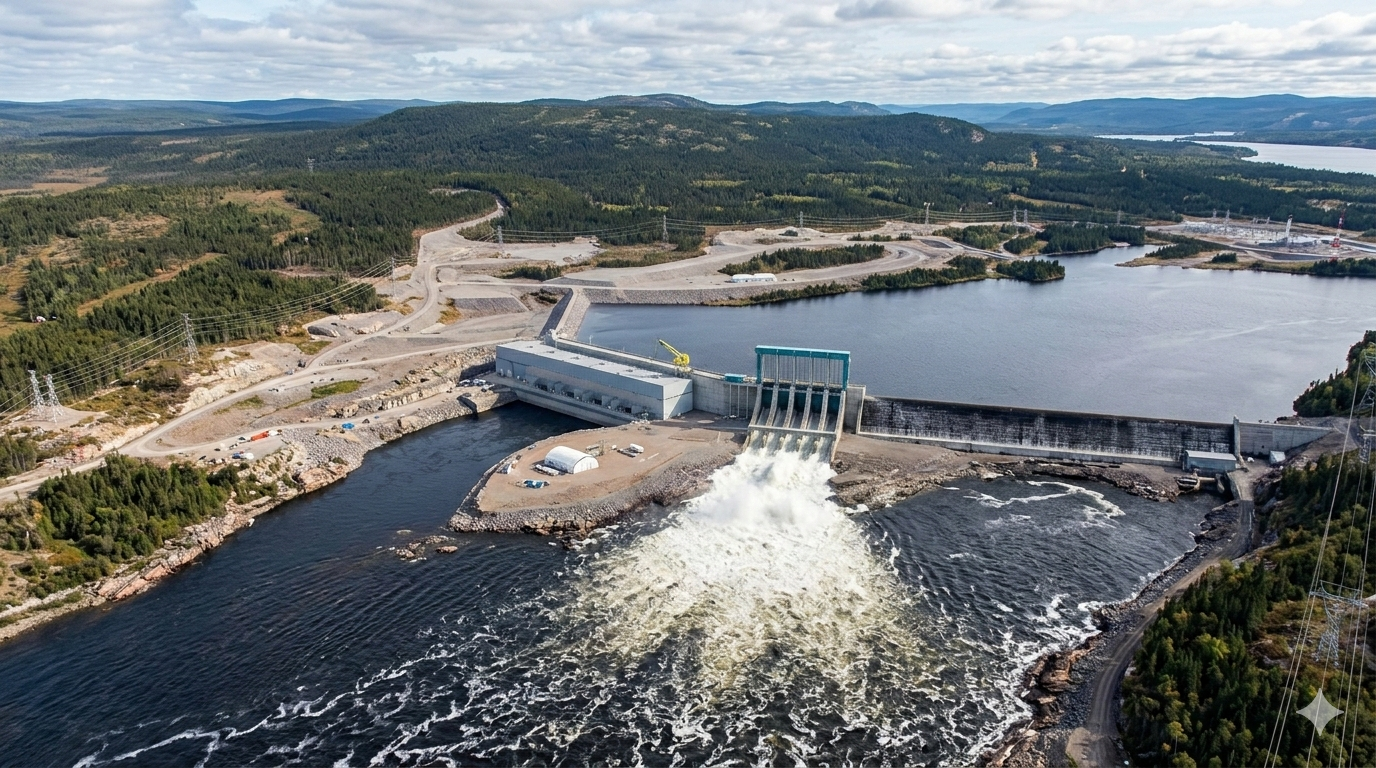
This paper uses Muskrat Falls to examine how cost estimates, financing, and governance shape public exposure in a major hydroelectric project. It traces the connection between approval decisions, construction risks, and the distribution of costs across the generating station and transmission links. It also examines questions over methylmercury mitigation and Indigenous consultation.
Project network
The generating station and transmission links work as a regional system. The generating station is in Labrador. The Labrador–Island Link brings electricity to Newfoundland’s grid, and the Maritime Link connects Newfoundland to Nova Scotia. The diagram follows the sequence shown in Appendix A.
Generation in Labrador
824 MW · The generating station is on the lower Churchill River. Nalcor, a provincial Crown corporation, owned the generating station.
Labrador to Newfoundland
About 1,100 km · The transmission corridor connects the Labrador project to Newfoundland’s grid. It crosses the Strait of Belle Isle and reaches the network near Soldiers Pond.
Newfoundland to Nova Scotia
About 180 km subsea · The Emera-developed link connects Newfoundland to Cape Breton. The subsea length describes this portion of the link, rather than the full interprovincial route.
The paper places construction’s start in 2013 and first generation in September 2020. Those milestones describe progress at the generating station within a larger system of transmission and financing agreements. Paper, pp. 2–3
Cost and financing
The 2012 sanction estimate for Muskrat Falls and its associated Nalcor-led transmission assets was $7.4 billion, including financing. The 2020 inquiry estimated $12.7 billion for that same project scope, about 72% above the sanction estimate. The $14.45 billion figure uses a wider scope that also includes Emera’s Maritime Link. The two views below explain the difference.
From sanction to the 2020 inquiry
Project and Maritime Link combined
| Cost category | Maritime Link | Nalcor-led assets | Combined |
|---|---|---|---|
| Construction | 1.60 | 10.10 | 11.70 |
| Interest and allowance during construction | 0.15 | 1.80 | 1.95 |
| Other | — | 0.80 | 0.80 |
| Total | 1.75 | 12.70 | 14.45 |
| Share of combined cost | 12.1% | 87.9% | 100.0% |
The paper traces two mechanisms for financing the public portion. Newfoundland and Labrador committed equity support to Nalcor, and federal loan guarantees helped the project borrow on more favourable terms. The inquiry found that Emera’s exposure to cost overruns was largely limited to the Maritime Link. The central planning question is which institution bears the extra cost when the estimate changes. Paper, pp. 7–9
Analytical themes
Cost estimates and approval
The paper connects early estimates to how governments evaluate affordability before committing funds. It draws on the inquiry’s examination of the information available at sanction and the oversight arrangements in place at the time.
Procurement and coordination
The paper compares the roles of the civil works, engineering management, and transmission contractors. Examples include a major civil works bid above the project estimate and warnings about the cost and scheduling risks of preparing the transmission right of way. These cases show how decisions on individual contracts can affect other parts of the project.
Ownership, guarantees and risk
The generating station was publicly owned through Nalcor. Private firms took part as contractors and, for some associated transmission infrastructure, as partners. The paper uses that distinction to examine how debt guarantees, ownership, and contractual limits affect where financial exposure sits.
Environmental and community concerns
The paper examines concerns about methylmercury associated with reservoir flooding. It describes the Independent Expert Advisory Committee’s recommendation to cap wetlands, support for that measure from Indigenous governments and affected communities, and Nalcor’s alternative proposal for a food storage and distribution fund. It uses the disagreement to ask how community concerns should shape mitigation decisions when they affect the schedule. Paper, pp. 12–13
Planning implications
The case highlights three tasks for infrastructure planning: scrutinize costs before sanction, identify who bears overruns, and involve affected communities early enough to influence project design and mitigation. Project maps reveal how assets depend on one another, while financial tables show which agreements determine who pays. Both are necessary to understand the scale and consequences of a regional infrastructure decision.
The public PDF omits the instructor’s name for privacy.
Original document